Are you still using « Middle East »?
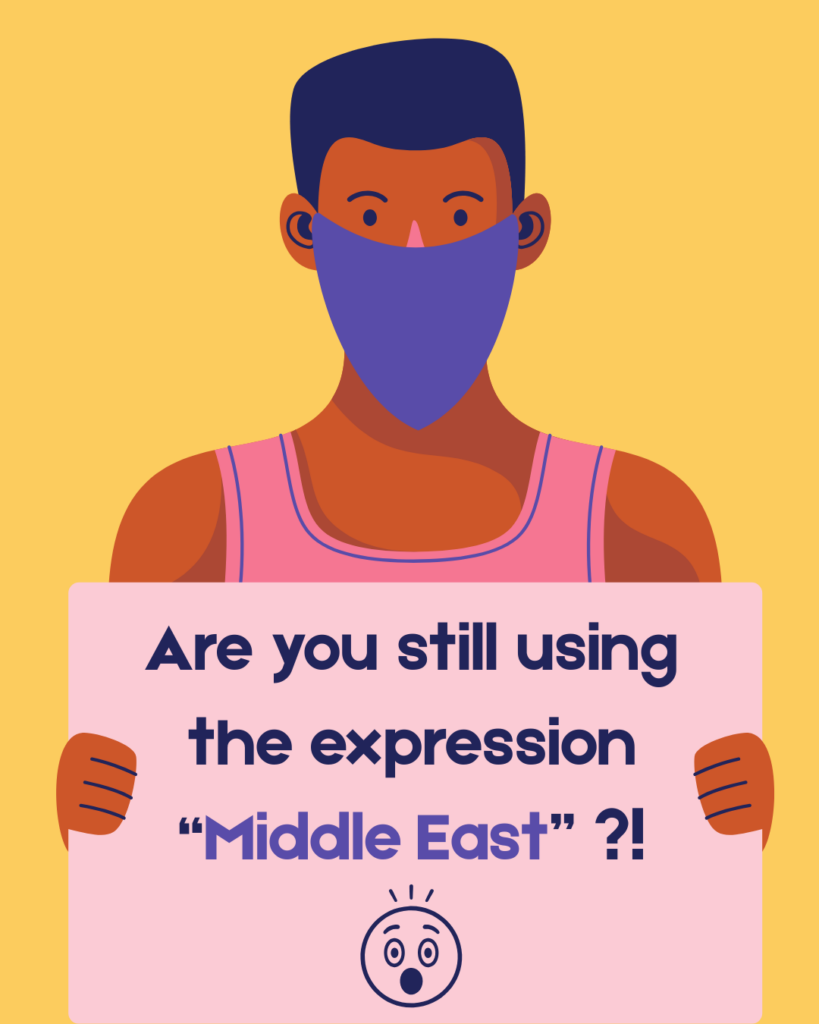
Are you still using the expression “Middle East”? What a great opportunity to talk about… colonial legacy!
🔎 What exactly are the East and the West?
The “East” is supposed to encompass the territories located to the east, and the “West” those located to the west.
Except that the Earth is round. So every country is to the east and west of another, all the time. So to the east and west of what?
Yes, of Europe. But Europe is not objectively in the middle of the map. We are faced with a glaring example of Eurocentrism.
⛔ Where do these terms come from?
These concepts were created to differentiate an “us”, the “West”, from “another”, the “East”, which has historically been depicted as less civilised and inferior, thereby legitimising interventionism and exploitation (you can look at Orientalist works to see this).
These terms are therefore historically racist and/or Islamophobic, and are sometimes still used today to portray BIPOC people or Muslim people as homogeneous groups (when in reality they are not!).
💡 What can we use instead?
Give the precise geographical names of the regions you are referring to. Taking the “Middle East” as an example, you could say “South-West Asia and North Africa” or “the SWANA region”.
If the reality you wish to discuss is not geographical, you can find more precise terms. Are you talking about cultural practices? Religion? Race? Economic circumstances?
Words do not merely describe the world, they shape the way we understand it. Continuing to use these expressions without questioning them means perpetuating a perspective inherited from colonialism.
If you’ve never thought about this before, and you understand French, you might be interested in my checklist for making your writing truly inclusive without spending hours on it, available here.
(By the way, since we’re talking about the topic, 🍉 as always)
—
👋 Hi! I’m Inès, I create and translate texts that change the world in English, Spanish and French.
✊ I write about inclusion, language and social justice. Follow me!
✉ You want your French communication to be inclusive? Send me a message!